Problem
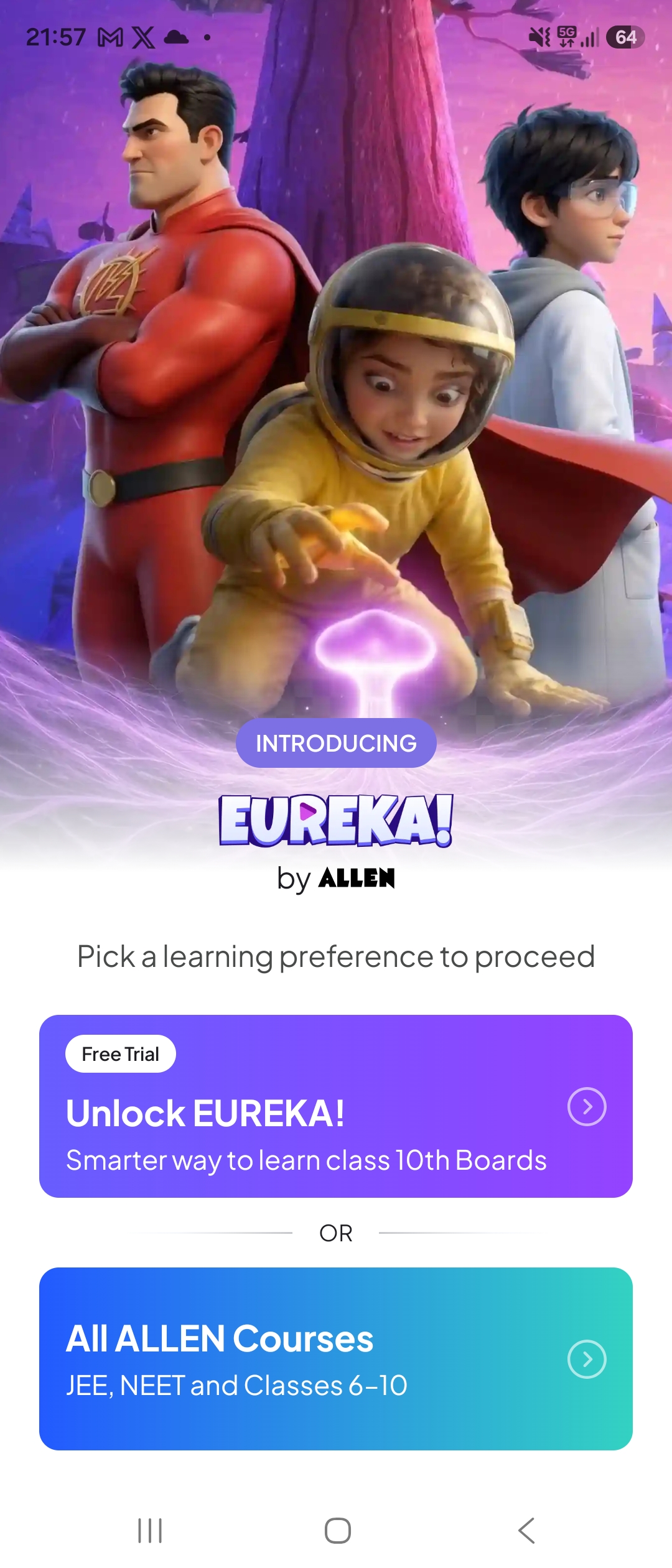
Eureka's existing free trial leans heavily on a countdown timer to manufacture urgency — but offers no clear guidance on what the student gets for free, what they're paying for, or what they lose when the trial expires. The result: students bypass the trial's intended benefits, jump straight to checkout, hit decision fatigue (Free vs Paid? Play vs Enroll? What's actually included?), and drop off before they ever experience real value.
Users
Class-10 board aspirants and their parents — first-time digital-learning buyers who care deeply about exam outcomes but are wary of online-course pricing. They want a continuous loop of watch → practice → track → clarify, and need confidence that the paid version is materially better than the free taste.
Hypothesis
If we replace the timer-driven, decision-heavy trial with a structured, progress-tracked, transparently-priced 6-day experience that lets students actually feel the learning loop end-to-end, then trial-completion will rise — and trial-completers will convert to paid enrollments with much higher confidence (and fewer refunds / churn).
Wireframes
I mapped the current (Confusion → Drop-Off) vs proposed (Clarity → Conversion) journeys and designed key surfaces: (1) a Trial Progress chip ("0/2 Chapters Completed") visible across the app; (2) a real-time Trial Status panel showing day-N-of-6, completed steps, and what's remaining; (3) context-aware CTAs that morph from "Continue Trial" mid-trial to "Enroll Now to Unlock Full Learning" post-trial; (4) a Full-Access value card (40+ lessons · 80+ practice sets · unlimited doubts) shown at the conversion moment.
Solution
A 6-day structured trial: 2 chapters · 40 min of video · 20 practice questions · 1 doubt session — sequenced as Lesson → Quiz → Progress checkpoint → repeat. Progress-based engagement nudges land at Day 3 ("1 chapter left — finish to unlock an exclusive enrollment discount"), Day 5 ("trial expires tomorrow — save your learning progress"), and on completion ("Unlock 40+ lessons, 80+ practice sets, unlimited doubts"). The conversion is reframed: from a 1-time purchase into a 1-year subscription → continuous learning ladder.
Inside the teardown.


Why this teardown stuck with me.
What pulled me into this teardown wasn't the timer — it was the gap between effort and confidence. Students were being asked to commit before they had a single completed milestone they could point to. The structured trial flips that: by the time the paywall appears, the student has already finished a chapter, attempted a quiz, and seen their own progress chip move from 0/2 → 1/2. The 'should I buy?' question quietly becomes 'I'm already learning here — why would I stop?'. That's the kind of product-led conversion I love designing for: where the funnel is the product, and the metric (enrollments) is a side-effect of the experience working.
What I'd take with me.
Urgency without clarity is just noise. Replacing a countdown timer with visible, completion-able milestones (chapters / quizzes) made the trial feel like real product value instead of a sales gate — and gave students an honest reason to enroll: they had already started learning.